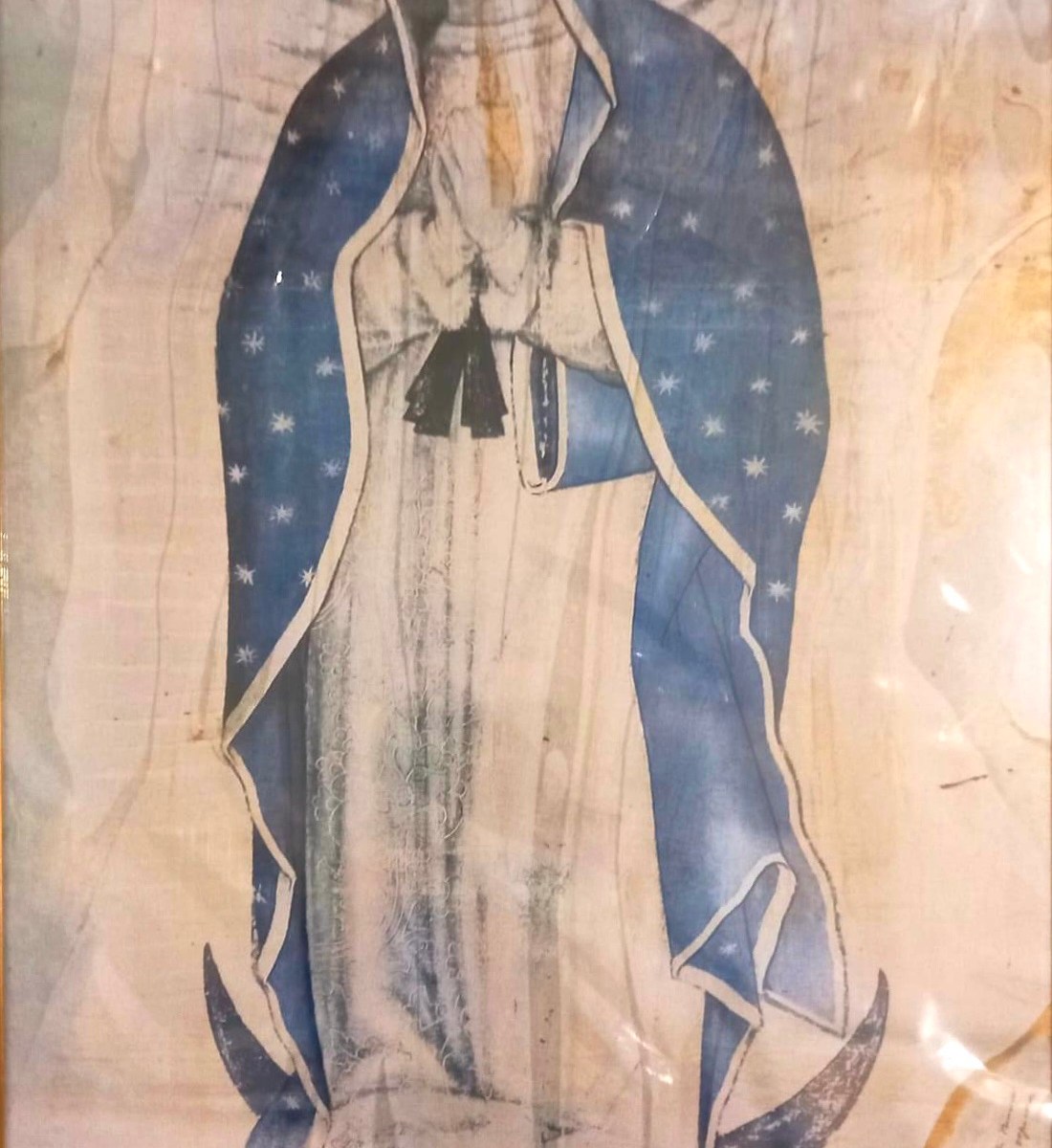
Am I not here, I, who am your Mother? Are you not under my shadow and protection?
Our Lady of Guadalupe to St Juan Diego in 1531
When people learn of my return to Christianity, and particularly to Catholicism, their questions tend to fall into one of two categories.
The first is usually some variation of: How do you reconcile this with divination?
The second is almost invariably: Why do Catholics worship Mary?
The latter question is especially common amongst those from Protestant backgrounds or from Christian traditions that developed outside the historic Churches of East and West. It is also one of those questions that has become so familiar that one almost ceases to hear it properly.
Yet it remains worth answering.
The simple answer is that neither the Eastern nor Western Churches have ever worshipped anyone except God. The accusation that Catholics worship Mary is an old cliché, but it is also an inaccurate one.
Veneration is not worship.
To venerate someone is to acknowledge virtue, honour a good example, and show respect. We do this constantly in ordinary life. We admire great writers, honour war heroes, and cherish the memory of those who have shaped our lives. None of this constitutes worship.
The Catholic tradition has always distinguished between the worship due to God alone and the honour shown to the saints.
Our Lady occupies a unique place within that tradition. The Church has traditionally referred to the honour given to her as hyperdulia, a special form of veneration accorded to the Mother of God because of her role in salvation history. Yet even this falls infinitely short of the adoration due to the Holy Trinity alone.
It is not worship.
Indeed, when Catholics ask for Our Lady’s intercession, they are doing nothing fundamentally different from asking a friend to pray for them. The assumption is simply that death does not sever the bonds between members of the Body of Christ.
What has always intrigued me is that many of the most common Marian devotions are profoundly Christocentric.
Consider the Rosary.
Whether one prays the traditional fifteen mysteries or the modern twenty, the focus remains upon the life of Christ. We contemplate the Annunciation, the the Crucifixion, the Institution of the Eucharist, and the Ascension. Through Mary’s eyes we are invited to reflect upon the mysteries of God made man.
Far from distracting attention from Christ, the Rosary directs it towards Him.
Pope Francis often observed that Our Lady always points towards her Son. I believe he was entirely correct.
Throughout the Gospels she consistently directs attention away from herself and towards God. Her words at Cana remain among the most concise summaries of Christian discipleship ever uttered:
Do whatever He tells you
John 2:5
In many respects that is the essence of Marian devotion.
Even during the three decades in which I considered myself separated from the Church, Our Lady remained curiously present in my life.
I continued to visit Marian shrines whilst travelling. I made rosaries. I kept icons. Whatever else changed, my affection for Our Lady never entirely disappeared.
My favourite image has always been the Eleusa, the icon of tenderness.
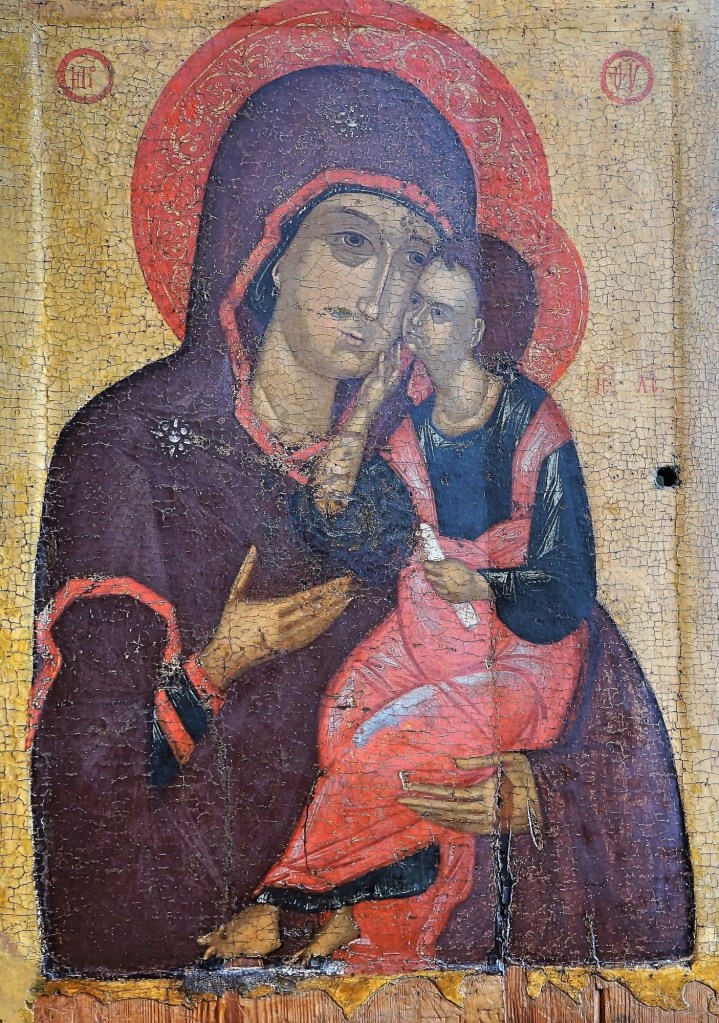
In these icons the Christ Child nestles against His mother’s cheek whilst she cradles Him close. The pose is strikingly intimate and profoundly human. There is no triumphalism. No distance. No grandeur imposed from without. Simply a mother and child bound together in affection.
There is something deeply moving about this naturalness.
The image reminds us that Christianity is not merely a collection of doctrines but the story of God entering human life. The Eternal became an infant. The Creator accepted the embrace of His own creation.
Whenever I look upon such icons, I am reminded of the words of Isaiah:
See, I have branded you on the palms of my hands, Your ramparts are always under my eye.
Isaiah 49:16
The Christian story is ultimately one of relationship. God does not remain distant but draws near. The Incarnation is the supreme expression of that nearness, and Mary stands at its centre because she is the one through whom God entered human history.
For this reason I have always regarded Our Lady as a symbol of God’s love for humanity and of humanity’s response to God.
She was immaculate, certainly.
Yet she was also profoundly human.
She experienced joy and sorrow. Wonder and uncertainty. Hope and grief. She pondered mysteries she did not fully understand. She accepted responsibilities she could scarcely have imagined. She stood at the foot of the Cross and witnessed the suffering of her Son.
What distinguishes her is not that she avoided suffering but that she received it with humility, faith, and trust.
Yet theology alone is not the reason that Our Lady occupies such an important place in my spiritual life.
In my darkest moments, it has often been Our Lady to whom I have turned first.
During periods of illness, bereavement, disappointment, anxiety, uncertainty, and grief, I have repeatedly found myself drawn towards her. Not because she replaces Christ or stands apart from Him, but because she makes His love tangible in a uniquely human way.
God is infinite, eternal, and beyond all human comprehension. We can know Him. We can love Him. Yet we cannot fully comprehend Him. The mystery of God is greater than the capacity of the human mind to contain.
Our Lady is different.
She remains entirely human.
We see in her a daughter, a wife, a mother, a mourner, and a disciple. We see someone who experienced uncertainty, fear, joy, sorrow, hope, and loss. We see someone who endured suffering not from a distance but from within the ordinary realities of human life.
For that reason, I have often felt that she bridges the distance that we sometimes imagine exists between ourselves and God.
Indeed, I genuinely believe this to be part of the reason Our Lord entrusted His Mother to us from the Cross.
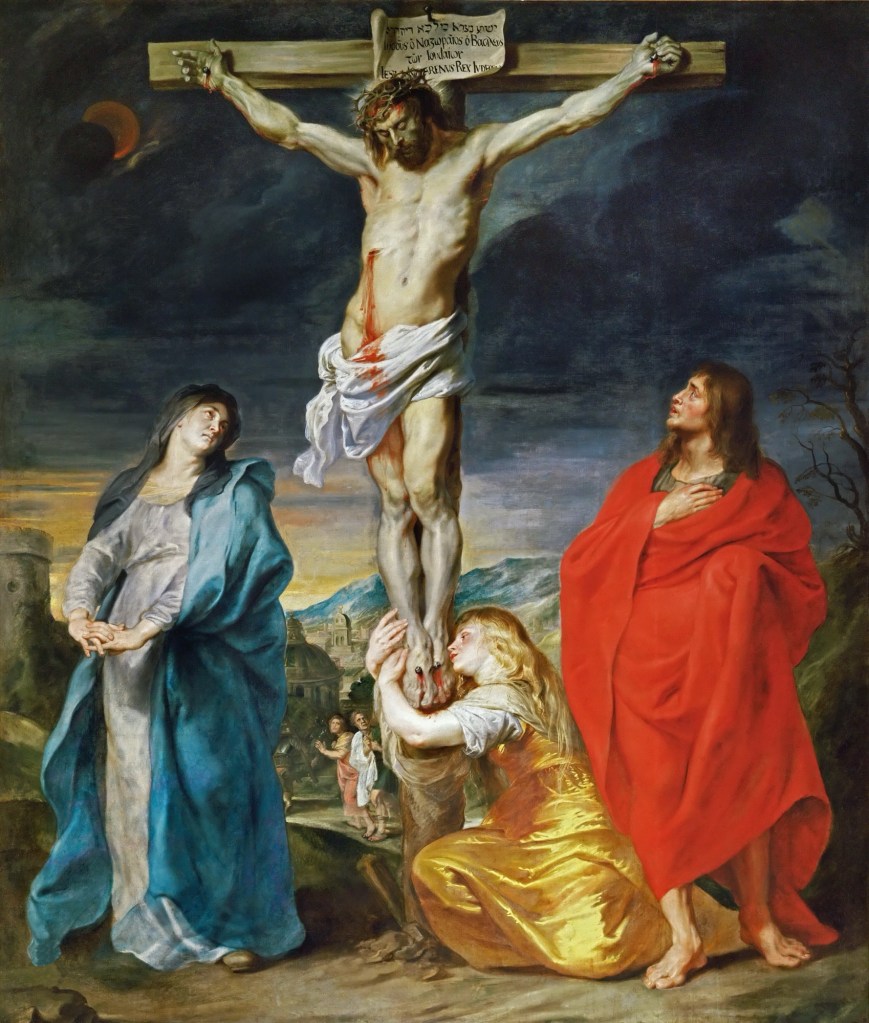
When He said:
This is your Mother
John 19:27
He was not merely addressing St John the Beloved. He was establishing a relationship that would extend throughout the life of the Church.
Christians rightly speak of God as Father.
Yet Christ, in His final moments, also gave us a Mother.
A spiritual Mother.
One who prays for us, comforts us, encourages us, and accompanies us.
One who remains present when we feel abandoned.
One who understands suffering because she herself suffered.
One who understands grief because she stood beneath the Cross.
The older I become, the more deeply I appreciate the title Our Lady of Sorrows. It reminds us that holiness does not remove suffering from human life. Rather, it teaches us how suffering may be borne with dignity, faith, and hope.
When I contemplate the Eleusa icon, pray the Rosary, or meditate upon the Seven Sorrows, I am reminded that Christianity is ultimately a religion of relationship. God draws near to humanity, and Our Lady stands as one of the clearest signs of that nearness.
She reminds me that God’s love is neither abstract nor distant.
She reminds me that faith can coexist with uncertainty.
She reminds me that sorrow is not the end of the story.
She reminds me that grace is often found in quiet fidelity rather than dramatic experiences.
And perhaps most importantly of all, she reminds me that no matter how far one wanders, one is never beyond the reach of God’s mercy.
For me, that has always been the heart of Marian devotion.
Not worship.
Not sentimentality.
Simply the love of a spiritual Mother who never ceases to point her children towards her Son.
Hail, Mary, full of grace,
the Lord is with thee.
Blessed art thou amongst women
and blessed is the fruit of thy womb, Jesus.
Holy Mary, Mother of God,
pray for us sinners,
now and at the hour of our death.
Amen.
§
Biblical Quotes from the Original Jerusalem Bible.

