
The First Cards
My introduction to the Petit Lenormand came through my Aunt Elisa. The deck she used was a version of the pattern published by Dondorf, though I describe it as a version advisedly. To this day, I have never been entirely certain who printed the particular copy she owned, nor when it was produced. What I remember clearly, however, is its appearance. The cards were monochrome, with plain brown backs, rather austere by modern standards and entirely without the decorative embellishments that later became commonplace.
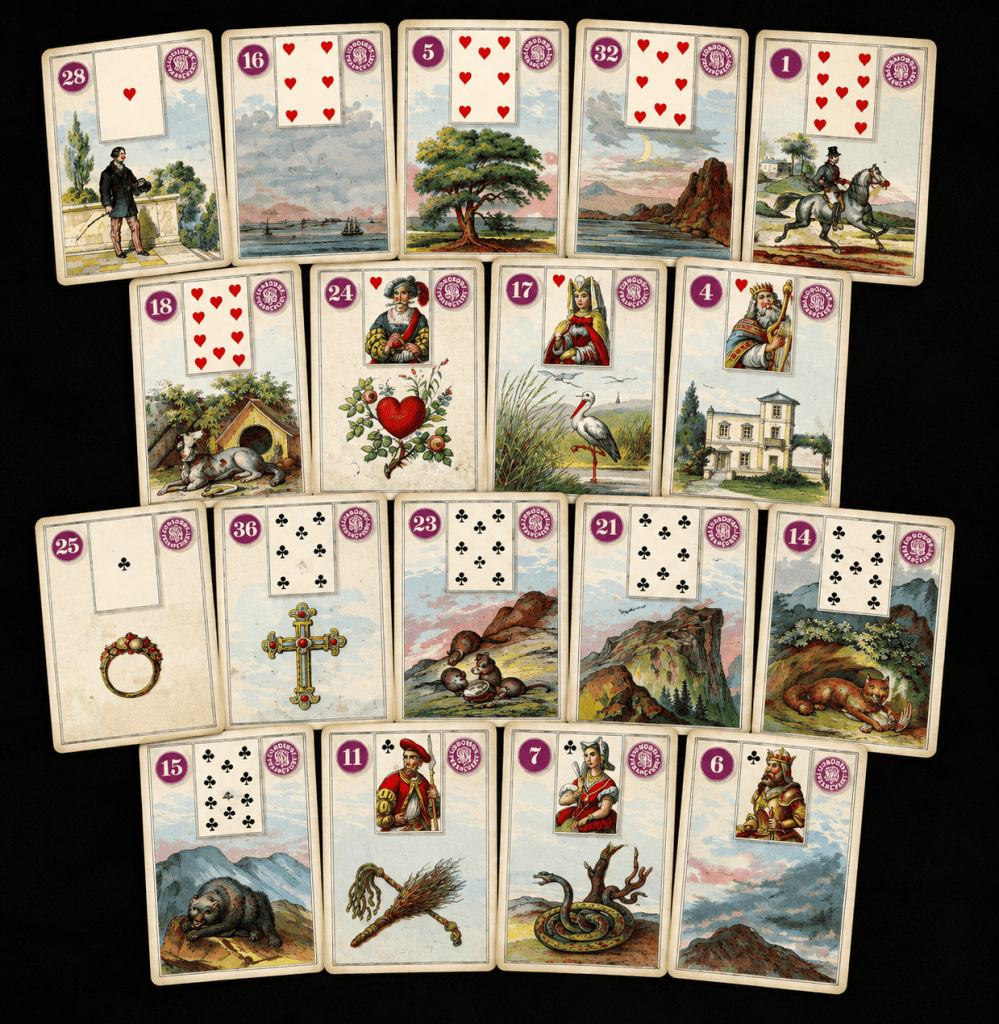
She possessed a spare set, although the Cross card was missing a corner and the Park had been creased. It was this deck that eventually found its way into my hands, and I used it throughout much of my childhood and into my early teens. Looking back, it is curious how little attention I paid to such imperfections. The damaged cards seemed no obstacle to reading. They were simply part of the deck, as natural and unremarkable as a crease in a favourite book.
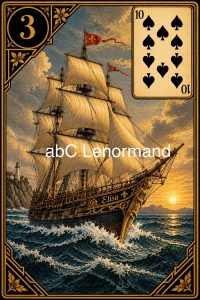
What strikes me now is that Aunt Elisa never, to the best of my recollection, referred to them as Lenormand cards. More often than not, they were simply the “cards.” Occasionally she would use an expression which, rendered into English, would translate roughly as “little tarot.” They belonged to that curious and rather appealing world of folk practice where precise classifications mattered far less than practical use. There were no discussions of schools, systems, correspondences, or historical lineages. The cards were simply there, brought out when required and put away when they were not.
Indeed, I only learned the name Lenormand much later. As a teenager, I showed the cards to the proprietor of a metaphysical bookshop in Brighton, who eventually identified them and introduced me to the wider tradition from which they came. It was a curious moment. Something that had always felt entirely ordinary and familiar suddenly acquired both a history and a name.
Shortly afterwards, I acquired Erna Droesbeke’s deck and book, which came paired with the now well-known Blaue Eule Lenormand. At the time, I was delighted. Not only did I possess my own copy of the cards, but I also had access to what was the first English-language works on the subject. The accompanying book opened doors that had previously been closed.
Yet, if I am honest, I never formed a real attachment to the deck itself.
The Blaue Eule cards struck me as rather maudlin and overly decorative. Where the old Dondorf pattern possessed a certain restraint and elegance, these seemed fussy, almost twee. They were perfectly serviceable for reading, and many readers remain genuinely fond of them, but I never wholly warmed to their aesthetic. It was perhaps my first lesson in the fact that two decks may contain precisely the same thirty-six symbols and yet evoke entirely different responses in the reader.
With hindsight, I suspect I spent many years searching for the atmosphere of those first cards.
Landscapes and Memory
In recent years I have increasingly come to the conclusion that one’s first deck, or perhaps more accurately the deck that establishes one’s connection with a system, casts a long shadow over everything that follows. We speak of favourite decks as though our preferences were entirely rational, but I am not convinced they are. The decks to which we are drawn often reflect something of that first meaningful encounter.
I can now see that many of the decks I have subsequently loved share characteristics with the old Dondorf. Over time, I have come to think of them as landscaped Lenormands. By this I mean decks in which the central symbol exists within a wider visual environment rather than floating in isolation against a plain background.
The old Dondorf cards possessed this quality. The Cavalier did not simply appear as a rider, nor the Ship merely as a ship. They inhabited landscapes. There were horizons, buildings, trees, roads, skies, and small incidental details that gave the impression of a living world. When laid out together in a tableau, the cards seemed to belong to the same universe. The eye could wander naturally from one scene to another.
This has remained an important consideration for me ever since. Whilst I appreciate the clarity of decks that emphasise the central symbol alone, they rarely hold my attention for long. I find myself preferring decks that create a sense of place and atmosphere. The cards become not merely symbols but windows into an imagined landscape.
Only recently have I realised how much this preference owes to those first cards. What I once assumed was a matter of taste may, in fact, be a form of memory. The decks that continue to speak to me most strongly are those that, consciously or otherwise, echo the aesthetic qualities of Aunt Elisa’s old cards.
The deck itself may have changed many times. The aesthetic, however, has remained remarkably consistent.
France, Ostend and New Horizon
During my late teens, I spent a great deal of time travelling to France and visiting family in Ostend, Belgium. It was during these journeys that my understanding of the Petit Lenormand began to expand considerably. For the first time, I encountered books and materials that were largely unavailable in English. It was also during this period that I acquired the works of Mary Marco and Jeanine Goffinet, whose influence upon my reading was considerable – not so much card meanings but approach and spreads.
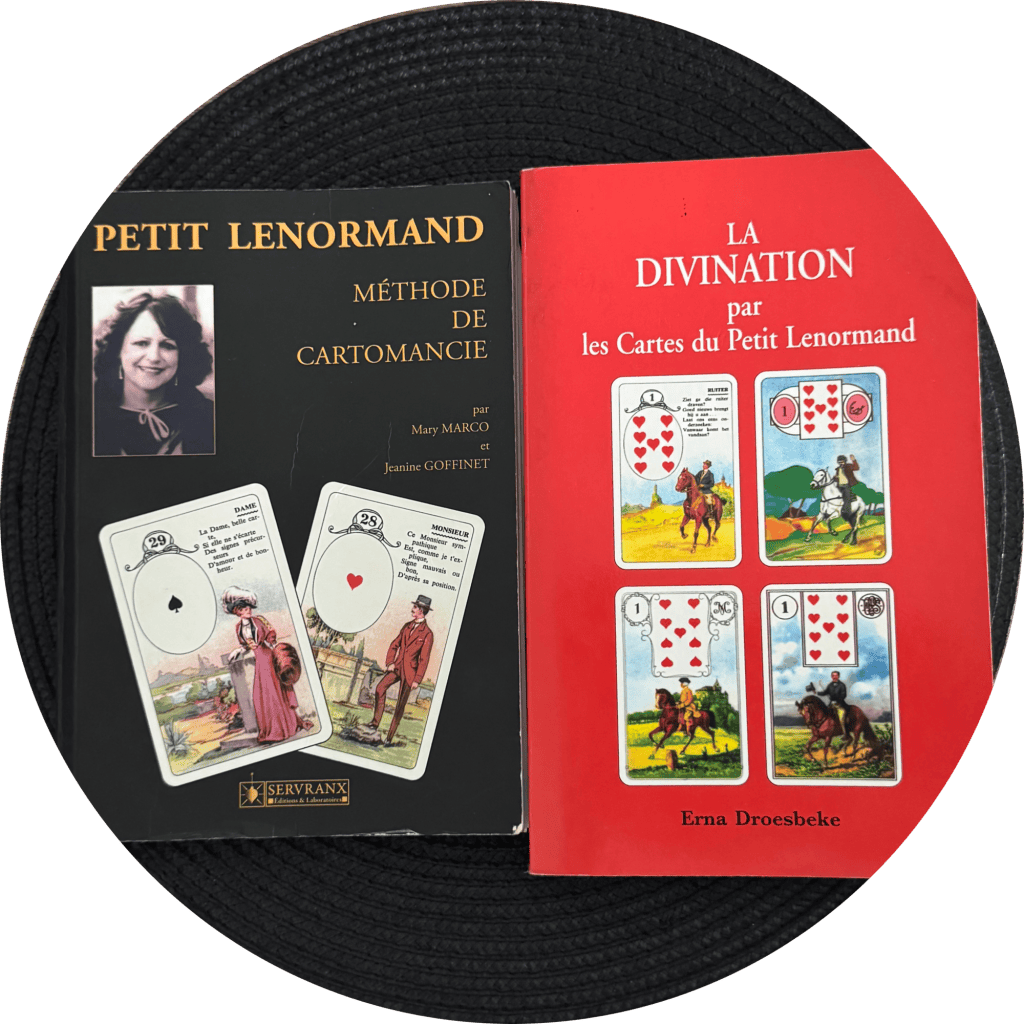
Alongside the books came new decks.
The third Petit Lenormand to enter my life was a Piatnik edition. It was not a new deck when I acquired it and differed in several respects from the versions I later encountered. The Lady and Child cards, in particular, were noticeably different from the patterns with which most readers are familiar today.
I loved it immediately.
The deck possessed a character and atmosphere that appealed to me far more than the Blaue Eule. It felt clearer, more elegant, and somehow more substantial. For a time, it became my preferred deck.
Then things began to go wrong.
Every reading seemed to produce the most unfortunate predictions imaginable. Accidents, deaths, arguments, losses, and difficulties appeared with a monotonous regularity. More curious still were the physical effects that accompanied its use. Whenever I worked with the deck for any significant length of time, I would develop headaches, feelings of nausea, and an overwhelming lethargy.
Viewed from the passage of time, I am reluctant to draw firm conclusions. But I believe(d) that the cards had attracted a low-level entity, or residual energy.
The situation came to a head following a particularly unpleasant reading. Convinced that something was profoundly amiss, I took the deck some distance from my home and burned it.
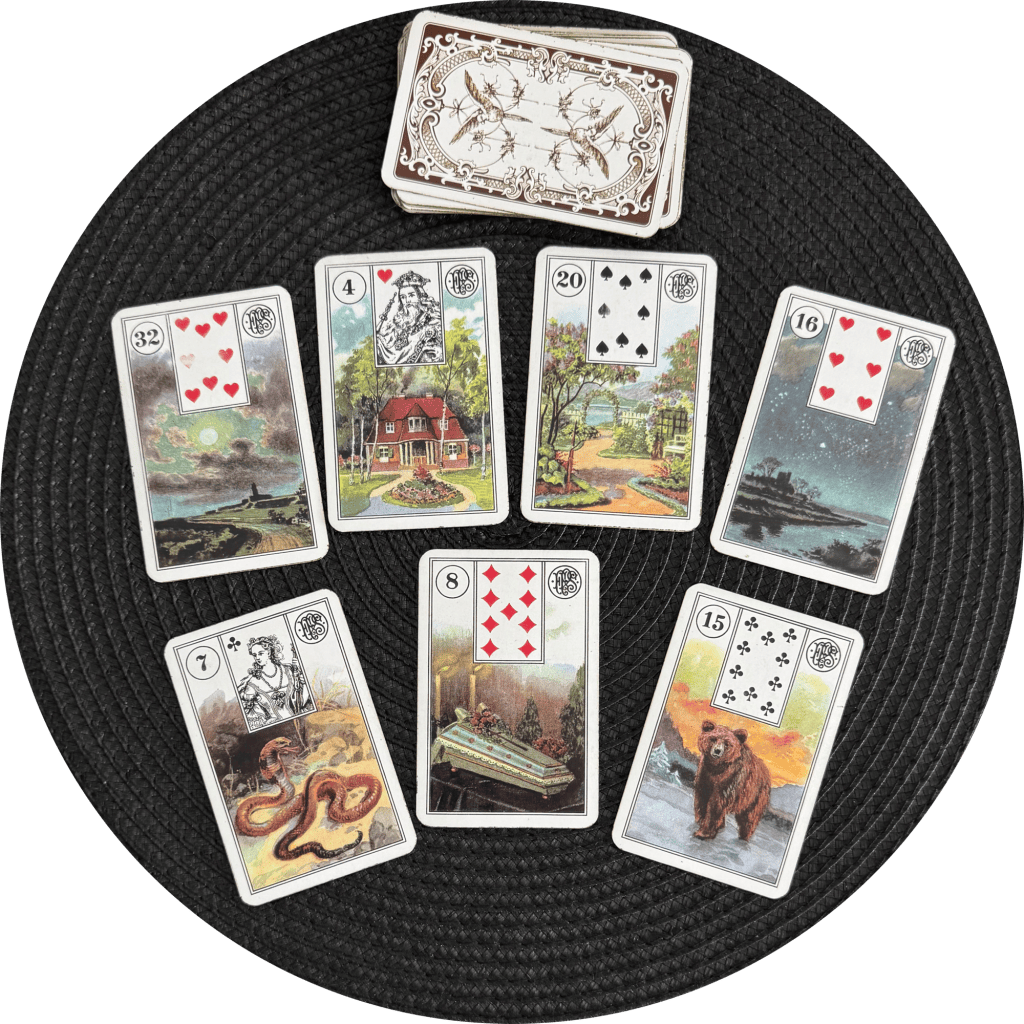
Whether I was destroying a troublesome object or merely exorcising a youthful fear, I cannot say.
What I do know is that for many years afterwards I would not even consider purchasing another Piatnik Lenormand. If asked, I would simply say that I did not care for the design and that I had never entirely understood why. It was easier than explaining the real story.
Only in 2018 did I finally revisit the pattern. By then the fears and superstitions of youth had long since faded, and curiosity got the better of me. I purchased another copy. Plus, I knew now the importance of clearing a deck.
To my surprise, I fell in love with the deck.
Not only were the old difficulties absent, but I found it one of the most attractive and readable Lenormands I had ever owned.
The experience taught me a lesson that extends rather beyond card reading. Sometimes we spend years avoiding things because of a single unhappy encounter, only to discover later that it was never the thing itself we feared, but the person we once were when we encountered it.
The deck had not changed nearly as much as the reader. It is now my number two.
Euphemie
It was also during the early years of the new millennium that I met Euphemie Al-Ansari, who became both a teacher and one of the most memorable friends I have known. Her husband was my supervisor.
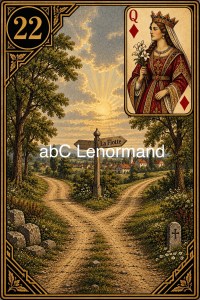
Whilst our shared interest in card reading first brought us together, it is not her technical knowledge that I remember most vividly. Rather, it is her friendship, generosity, and unapologetically individual character. Euphemie possessed strong opinions on almost everything and saw little reason to conceal them for the sake of social harmony. In an age increasingly concerned with consensus, she remained refreshingly indifferent to it. She made her own way and I dedicated the Paths in my deck to her.
Curiously, one of the few subjects on which we never reached complete agreement was the question of decks.
Euphemie was the only reader I knew who genuinely preferred the Eule patterns. Most often she worked with the Rote Eule, although from time to time she would return to the Blaue Eule. Her affection for them never diminished, despite my own rather ambivalent feelings.
This experience also leads me to question one of the commonly repeated assumptions within modern Lenormand circles, namely that the Blaue Eule represented some sort of standard continental deck. That was certainly not my experience. Throughout my visits to France and Belgium, and in encounters with readers from Germany and Switzerland, I never encountered anyone using the Blaue Eule. The few readers who favoured an Owl pattern generally used the Rote Eule. Far more commonly I encountered readers working with either the Piatnik or Carta Mundi editions.
With hindsight, I suspect the rise of the Blaue Eule owed less to widespread traditional use than to publishing history. Once Erna Droesbeke’s work was translated and released in French, English, and German alongside the deck itself, the pattern acquired a prominence that it might otherwise never have achieved. Prior to that the Rote Eule (with verses) seems to have been more accessible due to Muller’s licensing.
Whatever our differences regarding decks, Euphemie’s influence upon me was considerable. She constantly reminded me that card reading is ultimately about people rather than cards. Decks matter, certainly, but friendship matters more. Many years later, I remember far more about our conversations than I do about the cards that happened to be on the table.
Changing One’s Mind
The Piatnik deck taught me something else besides the dangers of allowing a single experience to harden into prejudice. It also demonstrated how readily we assume our opinions are final.
As readers, we often imagine that we either understand a deck or we do not. We like it or dislike it, connect with it or fail to connect with it, and assume the matter has been settled permanently. Experience has persuaded me otherwise.
Around 2006, I acquired Regula Fiechter and Urban Trösch’s Mystisches Lenormand. My reaction was decidedly mixed.
On the one hand, I greatly admired the artwork. I have always been fond of tempera as a medium, and there was something about the world Trösch created that I found immensely appealing. The cards possessed atmosphere and depth, hinting at stories unfolding beyond the boundaries of the illustrations. They seemed alive in a way that many modern decks do not.
Yet I struggled with the deck.
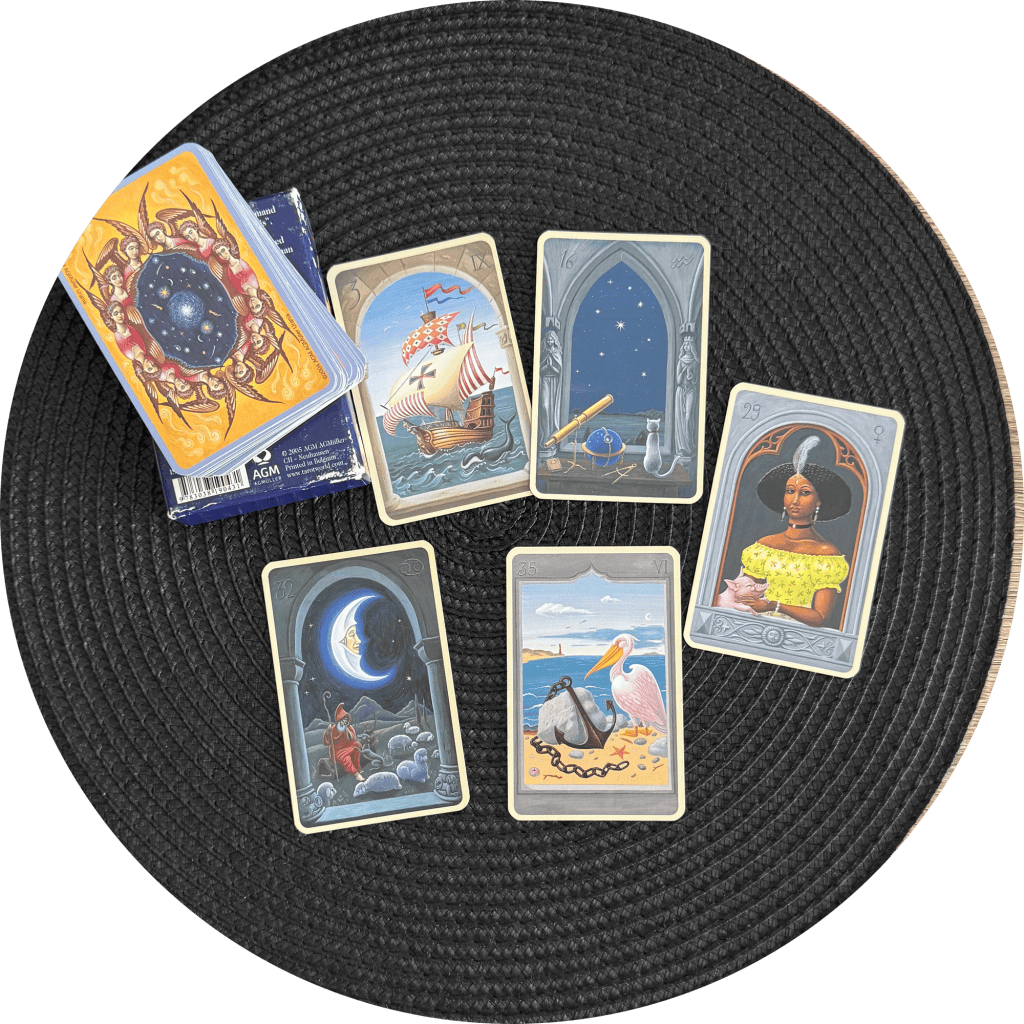
The imagery appeared saturated with symbolism and interpretative choices that I did not entirely understand. Whilst I continued to use it from time to time, partly because I had by then learned the value of keeping a second working deck to hand, I never felt wholly comfortable with it. Certain design decisions puzzled me, and I frequently found myself wondering what had motivated them. Eventually, I concluded that the deck simply was not for me.
Many years later, however, I encountered Regula Fiechter’s accompanying text.
Reading her explanations transformed the deck completely.
Questions that had lingered unresolved for years were suddenly answered. Choices that had once appeared arbitrary revealed themselves to be thoughtful and deliberate. The deck had not changed, but my understanding of it certainly had.
Time has persuaded me that I had made a common mistake. I assumed that a deck should reveal itself immediately to the reader. Sometimes precisely the opposite is true.
Certain decks require patience.
They demand context, study, and a willingness to approach them on their own terms rather than expecting them to conform to ours. What I had once dismissed as unnecessary complexity gradually revealed itself as richness.
The experience reminded me that our judgements frequently say as much about ourselves as they do about the objects we judge. As readers, we change. Our knowledge deepens, our interests evolve, and our points of reference shift. A deck that seems opaque at one stage of life may become entirely intelligible at another.
The Mystisches Lenormand taught me many things, but perhaps the most valuable lesson was intellectual humility.
Not every failure to understand is a defect in the deck.
Sometimes it is simply an invitation to look again.
My Lenormand
After the Piatnik incident, I eventually found myself gravitating towards the cards published by Carta Mundi under the title Jeu Lenormand Cartes de Bonne Aventure. These were the cards illustrated in the books of Mary Marco and Erna Droesbeke’s La Divination par les Cartes du Petit Lenormand. Much of the literature available to me employed this pattern, and it was also the deck most commonly used by the readers I encountered.
There was something immediately charming about it.
The illustrations possessed a simplicity and directness that appealed to me, and before long I had developed a genuine affection for the deck.
I generally used the version containing French verses, although I have also worked with editions containing German and Dutch text. Their presence never troubled me in the slightest, nor did they appear to concern my friends, family, or clients. On the contrary, they seemed an entirely natural part of the deck’s character and atmosphere.
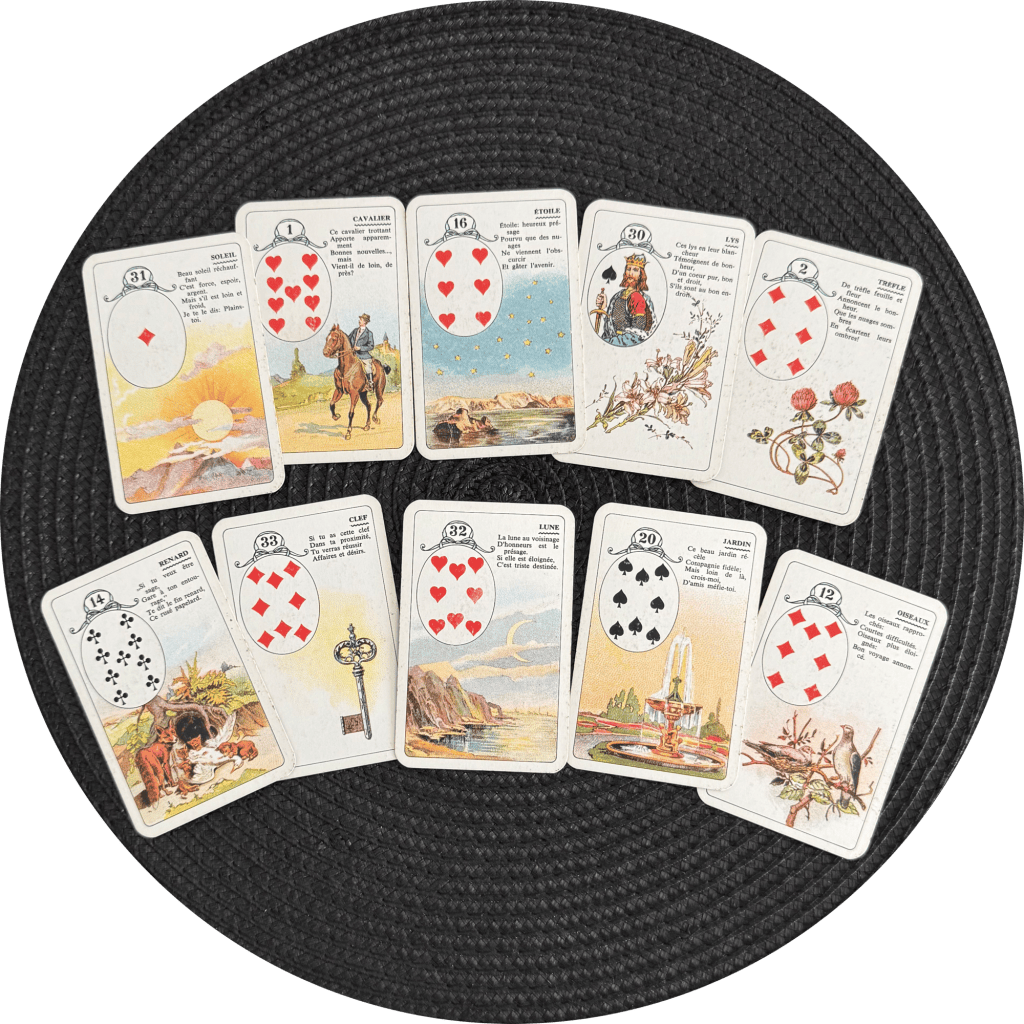
From approximately 1996 until 2010, this was the Petit Lenormand with which I conducted all my readings. I still perform the overwhelming majority of readings with it.
It remains my Lenormand. The version I use now is my third.
Although I greatly admired the Dondorf pattern, I always associated it strongly with my aunt. In a curious way, it felt like her deck rather than mine. Whenever I worked with it, I occasionally found myself wondering whether my interpretations departed from hers and, as a consequence, second-guessing my own judgement.
The Carta Mundi deck, by contrast, gradually became my own companion.
It allowed me to develop an independent relationship with the cards and a reading style that was distinctly my own.
Looking back, I suspect this was an important stage in my development as a reader. However much we may learn from our teachers and family, there comes a point at which we must cease reading through another person’s eyes and learn to trust our own.
I sometimes wonder what Aunt Elisa would have made of the directions my reading eventually took. We shared the same thirty-six cards, but we did not share the same life. Inevitably, our readings differed. Yet perhaps that is precisely how traditions survive. They are not preserved through imitation alone, but through adaptation. Each generation receives something and then quietly makes it its own.
The old Dondorf taught me how to read.
The Carta Mundi taught me how to read for myself.
Dialects of a Common Language
In recent years, the C. L. Wüst pattern has become one of my particular favourites, especially in the excellent restoration produced by The Wandering Oracle. There is something about its balance of clarity, atmosphere, and visual narrative that continues to reward repeated use. Like the old Dondorf, it inhabits a world rather than merely displaying a sequence of symbols. The cards feel lived in. One senses roads beyond the paths, towns beyond the horizon, and stories unfolding just outside the frame.
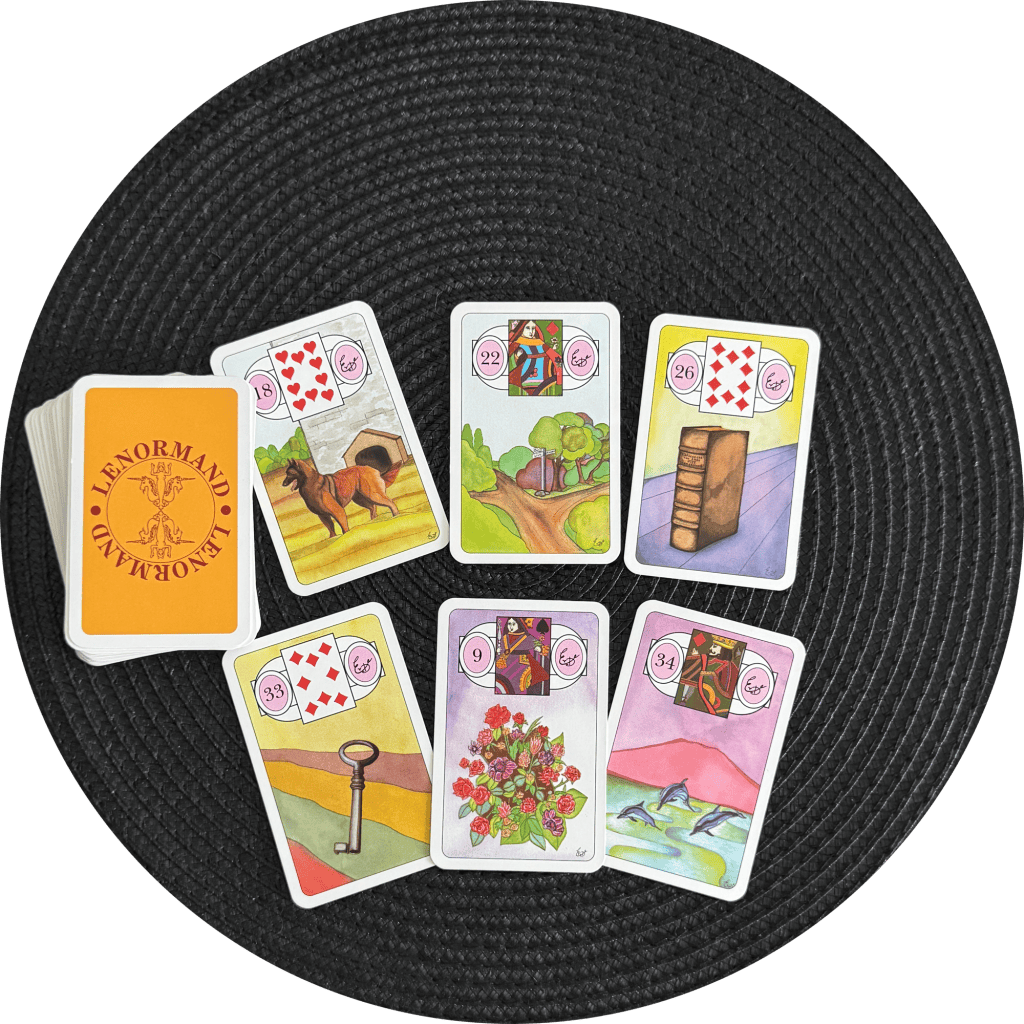
Yet, contrary to what some might suppose, I have never been one of those readers who believes that only historical decks deserve attention. On the contrary, some of the modern interpretations have given me enormous pleasure over the years. Erna Droesbeke’s Nieuwe Lenormand has long occupied a special place in my collection. I lost my first copy in Egypt and was genuinely bereft! Droesbeke manages a difficult balancing act, remaining recognisably Lenormand whilst also possessing a distinctive personality of its own.
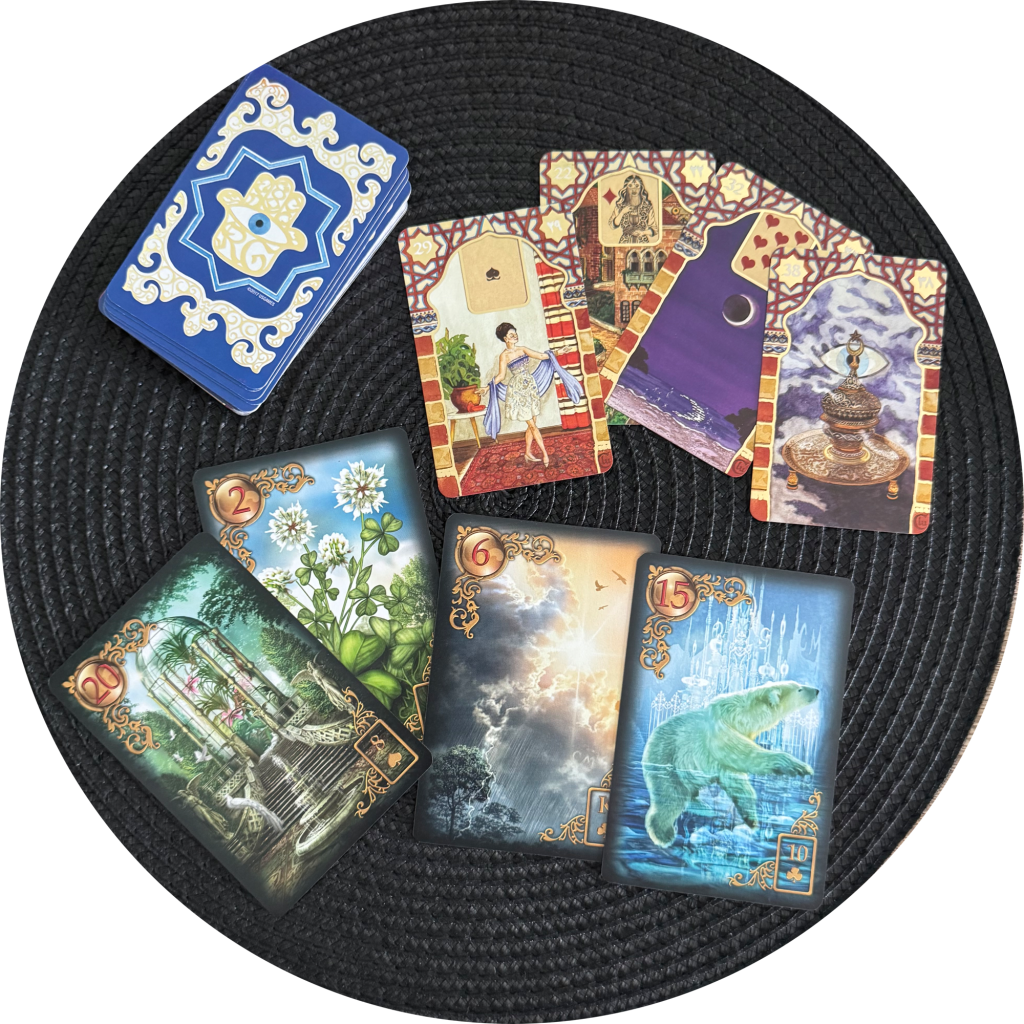
Likewise, I continue to return to Ciro Marchetti’s Gilded Reverie Lenormand and Rana George’s beautiful deck. Both demonstrate that innovation need not come at the expense of tradition. The former offers a richly realised visual world, whilst the latter combines practicality with elegance in a way I have always admired. Plus, Callie L. French’s art captures why we all love Rana!
More recently, I have become particularly enamoured with Irene Captijn’s seasonal Lenormand decks. They possess a warmth and atmosphere that I find immensely appealing. There is a gentleness to them, an attention to season, light, and place, that makes reading with them a distinctly pleasurable experience. Even the liberal use of pink doesn’t bother me! They also remind me that the Lenormand tradition remains a living one. New voices continue to join the conversation, and occasionally one encounters a deck that feels both fresh and familiar at the same time.
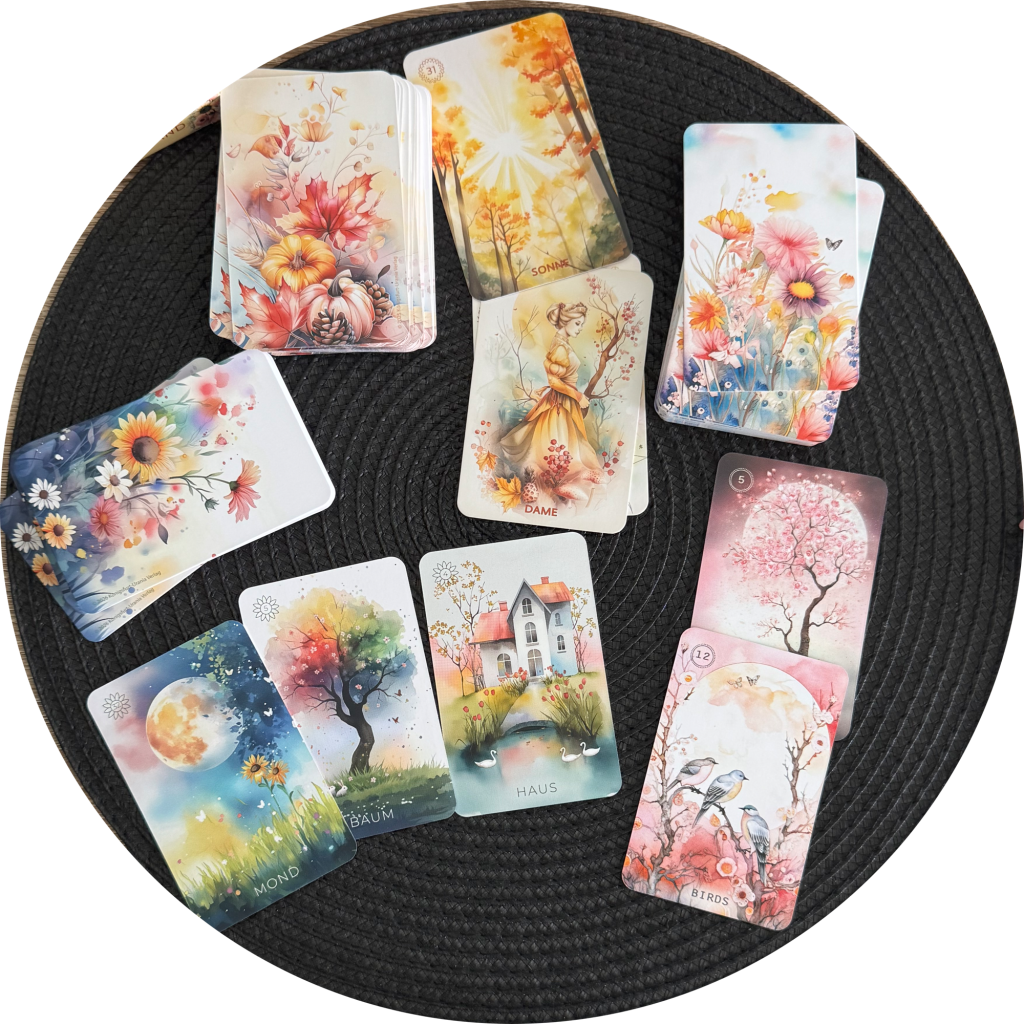
It is often assumed that I solely utilise decks which retain the playing-card inserts and, in truth, I generally do. Nevertheless, I have never excluded those that omit them. Whether depicted on the card or not, the Stars remain the Six of Hearts, the Paths remains the Queen of Diamonds, and the Child is still the Valet of Spades. The underlying playing-card correspondences do not cease to exist merely because they are not illustrated.
Consequently, the absence of the inserts does not prevent the cartomante from noting suit predominance, multiples, evaluating suit balance, or recognising the manifestation of particular court cards within a reading. These relationships remain part of the deck’s structure regardless of whether they are visually represented.
What is lost, however, is the ability to utilise the regards of the court cards. This can be a remarkably useful technique, adding nuance, clarification, and an additional layer of dialogue between the cards. Whilst I do not consider it indispensable, I do regard it as one of the genuine advantages of decks that display the inserts in full.
It is not, however, a decisive consideration. I continue to use and enjoy decks such as the Mystisches Lenormand, Gilded Reverie Lenormand, Summer Serenade Lenormand, and Autumn Embrace Lenormand, and Lo Scarabeo’s version of the Schneider & Co, despite their omission of the inserts. As with so much in cartomancy, what is gained in one area is often balanced by something gained elsewhere.
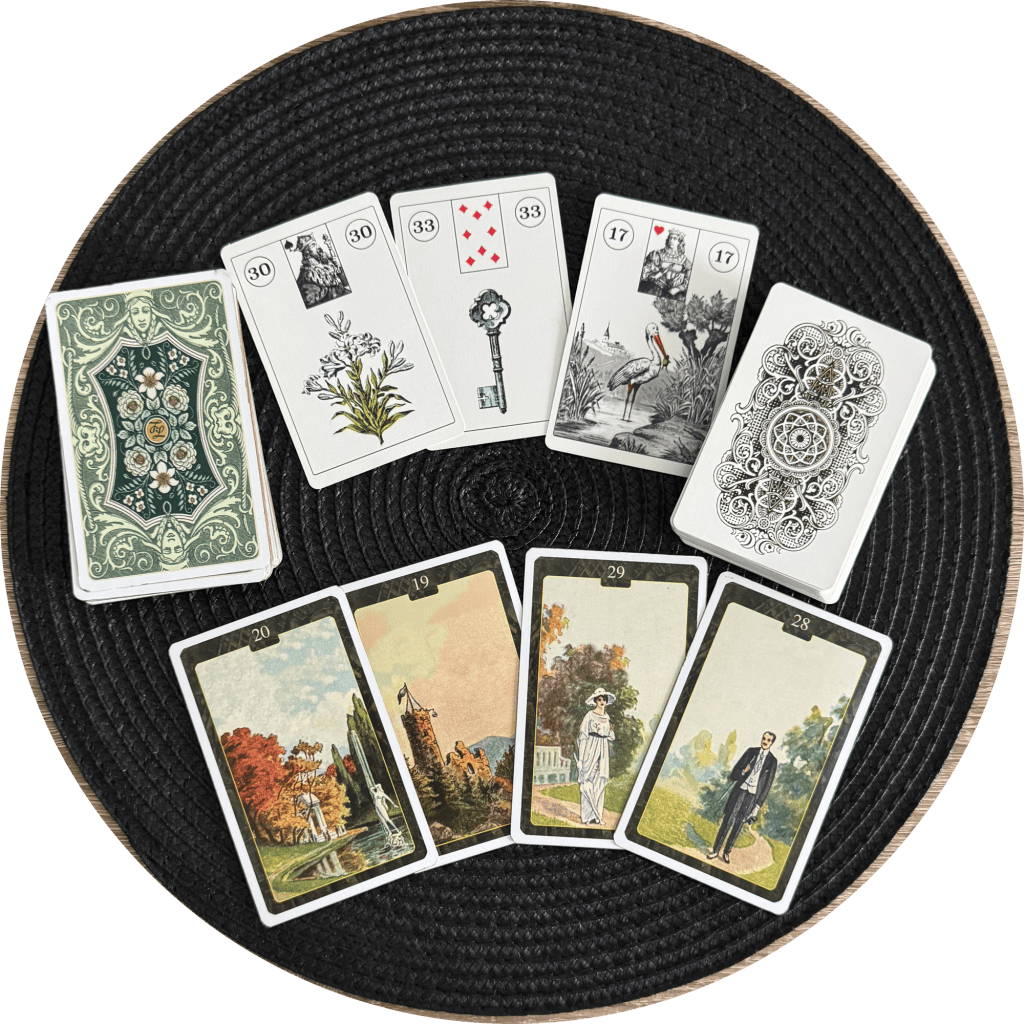
Over the years I have gradually come to view the various Petit Lenormands as gateways into a much larger universe. Each deck is recognisably Lenormand, yet each speaks with its own accent.
The relationship is rather like that between countries sharing a common language. The fundamental grammar remains the same, but the vocabulary, idioms, and rhythms differ from one place to another. The Game of Hope established the mother tongue from which all subsequent Lenormands descend. Since then, each artist and publisher has contributed a regional dialect of their own.
But they all remain recognisably members of the same family.
A reader who moves between decks soon discovers this for himself. One deck may prove direct and economical, another expansive and descriptive. One may emphasise atmosphere, another precision. One may feel rooted in the nineteenth century, another quite contemporary. Yet all remain mutually intelligible to those willing to learn their nuances.
I increasingly suspect that the deck with which we form the deepest connection is often the one whose language feels most natural to us. Its symbols become familiar, its peculiarities cease to seem peculiar, and eventually it begins to feel less like a set of cards and more like a native tongue.
We may learn many other dialects throughout our lives, and we may even come to love them, but there is usually one deck through which we think most naturally and to which we instinctively return.
For me, that deck remains the old Carta Mundi Jeu Lenormand Cartes de Bonne Aventure.
It is not necessarily the finest Lenormand ever produced, nor the most beautiful. Others may surpass it in historical significance, artistic merit, or technical sophistication.
It is simply the language in which I learned to speak Lenormand for myself.
§
Images:
Jeu Lenormand © Cartamundi, WanderWüst © Jorge/Wandering Oracle, Gilded Reverie Lenormand © US Games Systems, Inc. Rana George Lenormand © US Games Systems, Inc. Nieuwe Lenormand © Amber Studio/Erna Droesbeke, Lenormand 36 Orakelspielkarten © Königsfurt-Urania, Sweet Blossom Lenormand © Königsfurt-Urania, Summer Serenade © Königsfurt-Urania, Autumn’s Embrace Lenormand © Königsfurt-Urania, Lenormand Oracle © Lo Scarabeo, Mystisches Lenormand © Königsfurt-Urania.