One often hears discussions of fate and free will framed as though they were incompatible ideas. We are invited to choose between a universe governed by destiny and a universe governed by freedom, as if the existence of one necessarily excludes the other.
I have never found the opposition convincing.
Part of the difficulty, I suspect, arises from the fact that human beings experience reality through time. Our lives unfold sequentially. We move from yesterday to today and from today to tomorrow. We remember the past, experience the present, and anticipate the future. This process is so familiar that we rarely stop to question it.
Consequently, we tend to imagine that reality itself must be organised in precisely the same manner.

Yet Christian theology has traditionally taken a rather different view.
When theologians speak of God as eternal, they do not merely mean that He has existed for an exceptionally long time. Eternity is not an infinite extension of the clock. God is not ancient in the way that a mountain or a civilisation might be ancient. Rather, God exists beyond time altogether. The divine perspective is not one of endless duration but of what theologians have often described as an eternal present, a reality within which all moments are held together.
For us there is a distinction between yesterday, today, and tomorrow. For God there is only the eternal now.
This is, of course, difficult to imagine because every human thought is conditioned by temporal experience. We know what it means to wait. We know what it means to remember. We know what it means to anticipate. Yet God neither waits for the future nor recalls the past. The entirety of creation exists immediately before Him.
What appears to us as future therefore remains future only from our own limited perspective.
At first glance this may appear to threaten the idea of free will. After all, if God sees all things, is anything truly free?
I would suggest precisely the opposite.
The common assumption is that freedom consists in the ability to control events. Yet very little in life is actually subject to our control. We do not choose the era into which we are born. We do not choose our families, our natural talents, our physical limitations, or many of the circumstances that shape our lives. Even the most powerful individuals discover that events frequently refuse to conform to their wishes.
If freedom means absolute control, then none of us is truly free.
The classical Christian tradition understands freedom rather differently. Freedom is not the capacity to do whatever one pleases. Rather, it is the exercise of reason and the ability to choose the good. St Augustine repeatedly returns to this theme. Human beings are most free, not when they pursue every passing desire, but when their desires are rightly ordered.
In this sense, free will is not simply choosing between alternatives. It is learning to choose wisely.
The Neoplatonic thinkers developed a similar understanding. For Marsilio Ficino and Giovanni Pico della Mirandola, the soul possesses the freedom to direct itself. It may turn towards what is higher or towards what is lower. It may pursue wisdom or folly. Yet this freedom exists within an ordered cosmos whose ultimate source and destination remain divine.

Indeed, I have often wondered whether many disputes concerning fate and free will arise because the word destiny is misunderstood.
Destiny is frequently imagined as a script from which no deviation is possible, a rigid sequence of events imposed upon the individual irrespective of their choices. Such a conception has never appealed to me. It portrays human beings as little more than actors reciting lines.
Providence, as I understand it, is something quite different.
A traveller may know the destination of a journey without knowing every step that will be taken along the way. There are roads that lead directly towards the goal and roads that wander. There are delays, diversions, wrong turns, and unexpected discoveries. Yet the existence of a destination does not eliminate the reality of choice.
Life seems to me rather similar.
Our ultimate destiny is union with the Good, which is God. How we respond to that calling, however, remains a matter of freedom. Thus destiny and free will are not enemies. They are complementary realities that can only be properly understood in relation to one another.
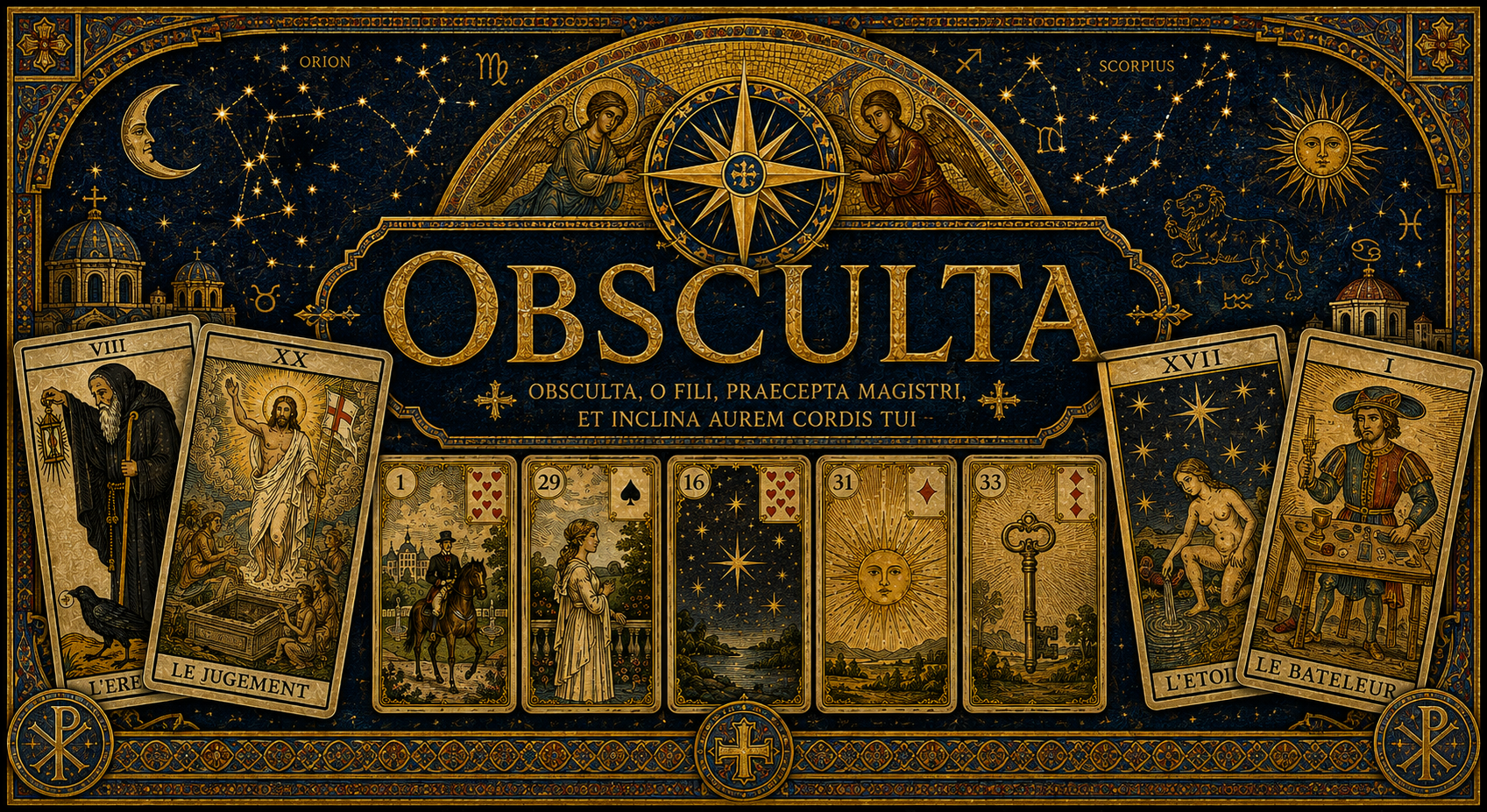
It is perhaps no coincidence that this understanding has also shaped my approach to divination.
Many people imagine that fortune telling concerns itself solely with fixed predictions. One asks what will happen and expects a definitive answer. Yet that has never been my experience.
At its best, divination reveals patterns rather than certainties. It illuminates tendencies, influences, opportunities, obstacles, and possibilities. It helps us understand the forces at work in a situation and the directions in which events may be moving. It does not abolish choice any more than a weather forecast abolishes the freedom to carry an umbrella.
Indeed, I often think that divination and fortune telling are best understood as two aspects of a single activity. Divination concerns itself with causes, influences, and underlying realities. Fortune telling concerns itself with the events and effects that emerge from them. One asks why and in what direction; the other asks what follows.
Both are valuable. Neither is complete without the other.
The older I become, the less interested I am solely in the question, “What will happen?”
Important though it may appear, it is rarely the deepest question.
Far more interesting are the questions that lie beneath it. More and more I want know why and:
- How ought I to respond?
- What is being asked of me?
- What virtues are required in this situation?
- Am I moving closer to the good or further away from it?
- What kind of person am I becoming?
These are questions that concern saints and philosophers no less than astrologers and card readers.
Whether one consults cards, studies stars, reads scripture, or simply reflects in silence, the ultimate purpose is not merely to know the future. It is to understand it with wisdom and grow in wisdom.
Perhaps that is why I continue to find both theology and divination so fascinating. Each, in its own way, reminds us that our lives form part of a larger story, one whose meaning cannot be reduced to the next event or the next decision.
We travel through time moment by moment. God sees the whole journey at once.
And somewhere between those two perspectives, human freedom finds its place.
§
Images:
Featured Image:
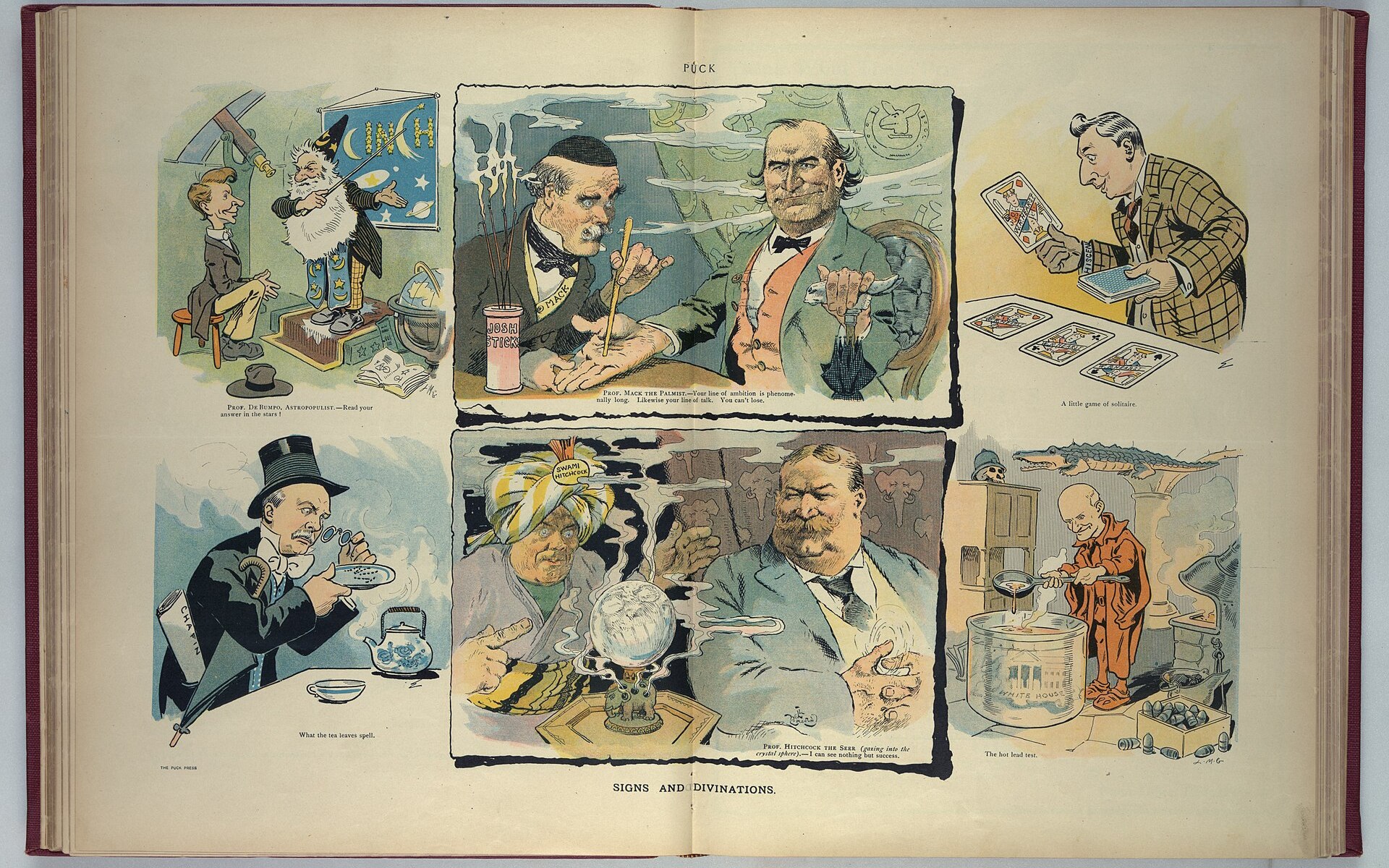
Crawford, Will, 1869-1944, artist; Glackens, L. M. (Louis M.), 1866-1933, artist; Ehrhart, S. D. (Samuel D.), approximately 1862-1937, artist, Public domain, via Wikimedia Commons

